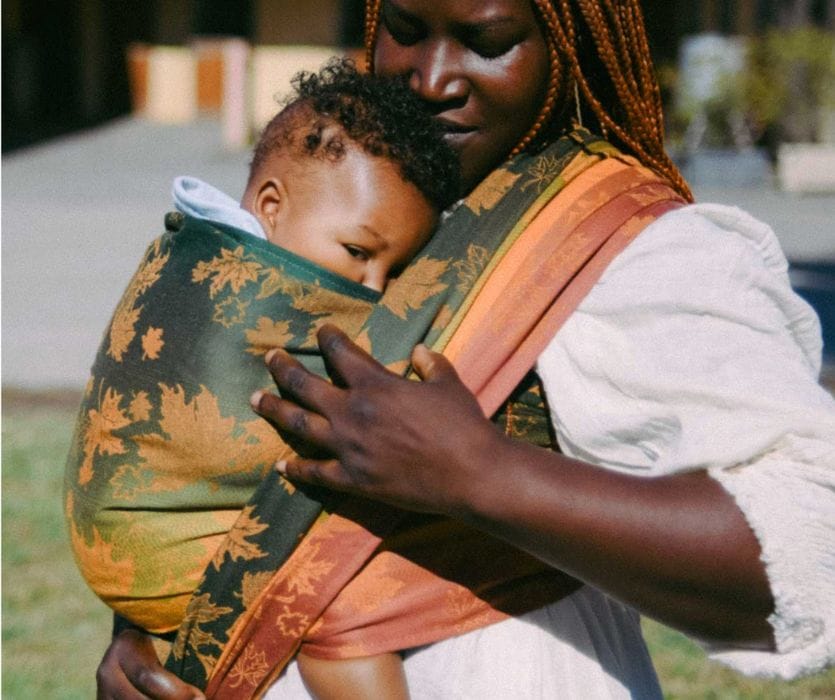
Fair warning: this is the post where babywearing gets a little more involved. Woven wraps and meh dais have a steeper learning curve than anything else we’ve covered in this series — but they also offer things no other carrier type can. More versatility, more carry positions, more ways to distribute weight comfortably, and for many parents, a genuine enjoyment of the practice itself.
If you’re a first-time parent still figuring out the basics, this might be something to bookmark for later. If you’ve already tried a stretchy wrap or buckle carrier and found yourself wanting more, keep reading.
What you’ll find here:
- What woven wraps are and how they differ from stretchy wraps
- How sizing works — and why it matters
- How to wear your baby in one
- What a meh dai is and how it differs from a woven wrap
- Honest pros and cons of each
- A note on cultural context
- How to know if either is right for you
- Brands worth knowing about
What Is a Woven Wrap?
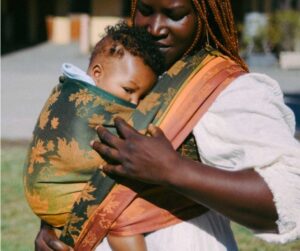
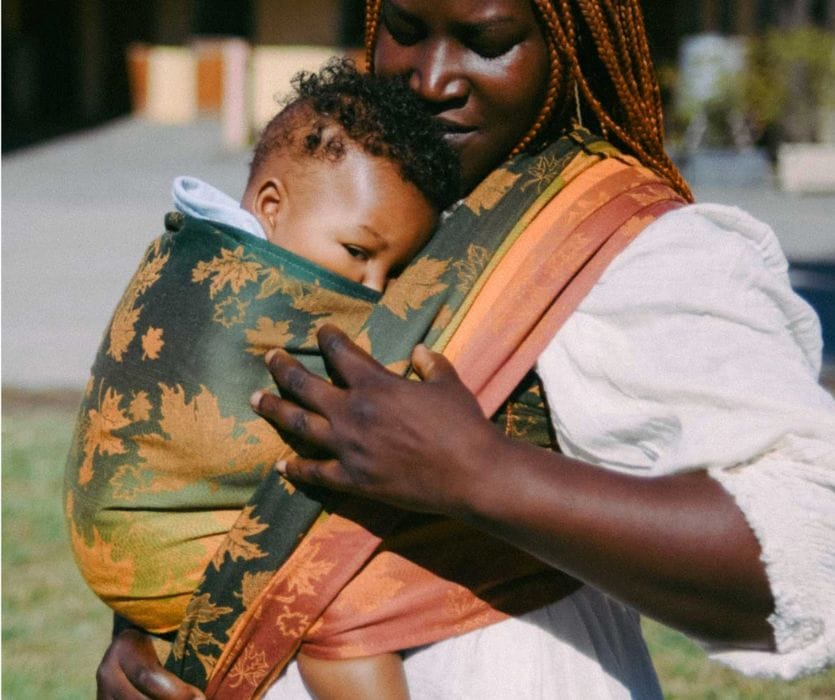
A woven wrap is a long piece of fabric — woven rather than knit, which means it doesn’t stretch — that you tie around yourself and your baby. If you have a Moby or Boba Wrap, that’s a stretchy wrap and a different thing entirely. Woven wraps are firmer, more supportive, and significantly more versatile.
The lack of stretch is actually what makes them so capable. Because the fabric doesn’t give, you can achieve a precise, secure fit that holds its position — which is what allows woven wraps to support back carries, hip carries, and a wide range of positions that stretchy wraps simply can’t do.
They come in a wide range of fabrics — cotton, linen, hemp, silk, wool, and blends — and in different weights (measured in grams per square meter, or GSM). Lighter weight wraps tend to be easier to learn with and cooler in warm weather. Heavier wraps are more cushioning and supportive but take longer to break in.
How Does Sizing Work?
This is the part that confuses most people, so let’s make it simple.
Woven wraps are sold in numerical sizes — typically 1 through 8 — each corresponding to a specific length. The size you need depends on your body size, your baby’s size, and what carry you want to do.
The most important size to know is your base size — the size that lets you do a Front Wrap Cross Carry (FWCC), which is the foundational carry most people learn first. Here’s a rough guide to help you find your starting point — keep in mind these are approximate and vary by brand and body shape:
Your clothing size = Approximate base size
XS–S = Size 4–5
M = Size 5–6
L–XL = Size 6–7
XXL+ = Size 7–8
If you’re wrapping a larger baby or toddler, round up a size. If you’re larger-chested than average, round up as well.
Your base minus 2 (so a size 4 if your base is 6) is the second most useful size to own — it works for a ruck back carry and many hip and front carries once you’re more experienced.
The reason babywearers use “base” as shorthand is that it eliminates body size from the conversation. Whether your base is a 4 or an 8, you can all do the same carries in your base size. It’s a common language that makes it easier to get advice and find the right wrap regardless of your size.
How Do You Wear Your Baby in a Woven Wrap?
This is where woven wraps genuinely shine. The range of carry positions is broader than any other carrier type:
Front carries — including Front Wrap Cross Carry (the most common starting point), kangaroo carry, and others.
Back carries — including the ruck back carry, which many parents find more comfortable than any front carry once baby is bigger. Back carries in a woven wrap can be done from the newborn stage by experienced wrappers, though most people start with front carries and work up.
Hip carries — excellent for babies who want to see the world without the limitations of forward facing.
The Front Wrap Cross Carry is where almost everyone starts, and for good reason — three layers of fabric mean even an imperfect first attempt is generally safe, which gives beginners room to learn without as much anxiety about getting it exactly right.
What Is a Meh Dai?
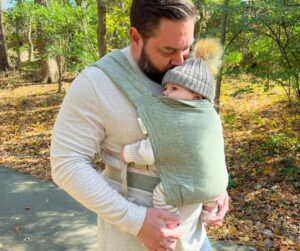
A meh dai (sometimes written mei dai, though meh dai is the preferred spelling — more on that below) is a rectangle of fabric with two sets of straps: one that ties around your waist and one that goes over your shoulders. Think of it as a halfway point between a woven wrap and a buckle carrier — it has the structured panel of an SSC but ties with fabric straps rather than buckles.
Meh dais are significantly easier to learn than woven wraps while still offering much of the same versatility. They can be used for front and back carries, work for newborns through toddlers, and are adjustable enough to fit a wide range of body types. For parents who like the idea of wrapping but feel intimidated by the learning curve of a full woven wrap, a meh dai is often the perfect middle ground.
A Note on Language and Cultural Context
Both the meh dai and the onbuhimo (covered in the next post) have roots in Asian babywearing traditions that predate modern carrier brands by centuries. The language we use to talk about them matters.
Meh dai is Cantonese. Bei dai is Mandarin. The spelling “mei tai” was a translation error that became widespread — meh dai is more accurate and preferred. Some brands have created their own trademarked terms (like “Fly Tai”) that erase these cultural roots. The babywearing community generally asks that you use the actual term — meh dai — rather than brand-created alternatives, for the same reason you’d use someone’s actual name rather than a nickname they didn’t ask for.
This isn’t meant to make anyone feel bad for not knowing — most people don’t, because brands don’t tell you. It’s just worth knowing going forward.
The Honest Pros and Cons
Woven Wraps
What they do really well:
Maximum versatility. No other carrier type offers as many carry positions or as much ability to customize the fit for your specific body and baby.
Genuinely cool carrying option. A single-layer carry in a lightweight linen wrap is one of the coolest babywearing options available — especially compared to stretchy wraps or padded buckle carriers.
Grows with your baby. A good woven wrap works from newborn through toddler and beyond. It’s a genuine do-it-all carrier for parents willing to invest time in learning.
Can be beautiful. This sounds frivolous but it’s real — woven wraps come in extraordinary designs and textures, and many parents genuinely enjoy collecting and using them. It becomes a hobby for some people.
Where they fall short:
Steep learning curve. This is the honest truth. A woven wrap takes real practice to use well. Most parents need several weeks of regular use before it feels natural, and some positions — particularly back carries — take considerably longer.
Tails touch the ground. On wet or muddy days, the fabric tails will trail on the ground while you’re tying. It’s a minor inconvenience that comes up often enough to be worth mentioning.
Not quick on/off. If you need to get baby in and out frequently, a woven wrap is not your most practical option. A ring sling or buckle carrier will serve you better for quick trips.
Requires the ability to tie knots. For parents with arthritis or limited hand mobility, this can be a genuine barrier.
Meh Dais
What they do really well:
Easier learning curve than a woven wrap. The waist ties anchor the carrier in place, which makes it easier to get baby positioned correctly before tying the shoulder straps. Most parents feel confident within a few practice sessions.
Highly adjustable. Because nothing is pre-sewn into a fixed size, a meh dai can accommodate a very wide range of body types and baby sizes.
Versatile. Front and back carries, newborn through toddler. Some meh dais can also do hip carries.
Minimalist feel. No buckles, minimal padding — many parents prefer the cleaner look and feel.
Where they fall short:
Straps touch the ground. Same issue as woven wraps — tying involves fabric on the ground, which is less fun on wet days.
Minimal padding. Whether this is a pro or con depends entirely on your preferences. Some parents love the streamlined feel; others miss the cushioning of a buckle carrier for longer carries.
Not as quick as a buckle carrier. Faster than a woven wrap, but still involves tying. Not the best choice if speed is the priority.
Is a Woven Wrap or Meh Dai Right for You?
Consider a woven wrap if:
- You want maximum versatility and are willing to invest time in learning
- You plan to carry for a long time and want to keep options open as baby grows
- You live somewhere hot and want a genuinely cool single-layer carry
- You enjoy learning a new skill
Consider a meh dai if:
- You like the idea of wrapping but want something easier to learn
- You want the adjustability of a wrap with less fabric to manage
- You’re interested in back carrying earlier than most buckle carriers allow
- You want something minimalist without buckles and padding
Stick with something else if:
- Quick on/off is your top priority
- You have hand or wrist issues that make tying difficult
- You’re in the early newborn stage and just need something simple to start
Brands Worth Knowing About
Woven Wraps
Didymos One of the most established woven wrap brands, with decades of history. Their wraps are well-regarded for quality and longevity. They also make the Didyklick, a half-buckle that uses woven wrap fabric for the shoulder portion — a good bridge between a meh dai and a buckle carrier. You can see all the varieties on their site.
LennyLamb Highly recommended across parent communities for quality, design variety, and accessibility. Their wraps come in a wide range of weights and fabrics, making it easier to find a good starting point. Also makes the LennyLight SSC, so a good brand to know if you want to stay within one ecosystem. You can find them on the LennyLamb site.
Oscha A Scottish brand with a devoted following, known for beautiful designs and high-quality fabric. Their wraps tend to have a longer break-in period but are highly regarded once broken in. The Oscha Bairn (a half-buckle) is frequently recommended as a good entry point into the brand. You can see them all on the Oscha site.
Meh Dais
Girasol WrapMySol Frequently recommended as a beginner meh dai — the woven wrap fabric is supportive and the carry feels secure. I found a nice selection on Little Zen One.
Didymos DidyTai Uses Didymos woven wrap fabric for a supportive, adjustable carry. A good option if you already like the Didymos brand. Again, I found a nice selection on Little Zen One.
Hope & Plum Their meh dai gets mixed reviews compared to their Lark SSC — some parents love it, others find back carries less intuitive. Worth trying before buying if possible. Find them on the Hope & Plum site.
LennyLamb Wrap Tai Uses LennyLamb woven wrap fabric. Supportive and adjustable, consistent with the quality of their other products. Note: they didn’t have them on their site and I could only find them on Little Zen One. Not sure if they are phasing them out, redesigning or just low on stock.
Before You Buy
Woven wraps have a secondhand market unlike almost any other baby product — active, organized, and full of people who genuinely love what they’re selling. Facebook groups dedicated to woven wrap buy/sell/trade are easy to find and worth joining even before you’re ready to buy, just to get a sense of brands, prices, and what’s available. Many experienced babywearers buy wraps this way exclusively and find better quality at lower prices than buying new.
One practical note on fabric: if you’re brand new to woven wraps, resist the temptation to start with something very thick or stiff, even if it’s beautiful. A lower GSM wrap in a simple cotton or linen blend is dramatically easier to learn with.
The Full Series
- Overwhelmed by Baby Carriers? Here’s Where to Actually Start
- The Beginner’s Guide to Soft Structured Carriers
- Stretchy Wraps Are Magic for Newborns — Until They’re Not
- Ring Slings: What They Are, How They Work, and Why Parents Love Them
- What Is an Onbuhimo? Everything You Need to Know About This Underrated Carrier
- Just Tell Me Which Carrier to Buy: A Practical Guide for Overwhelmed Parents
This post may contain affiliate links. If you purchase through my links I may earn a small commission at no extra cost to you. Thanks for supporting Pregnant Chicken — it keeps the lights on and supports our free content. Updated February 2026.